
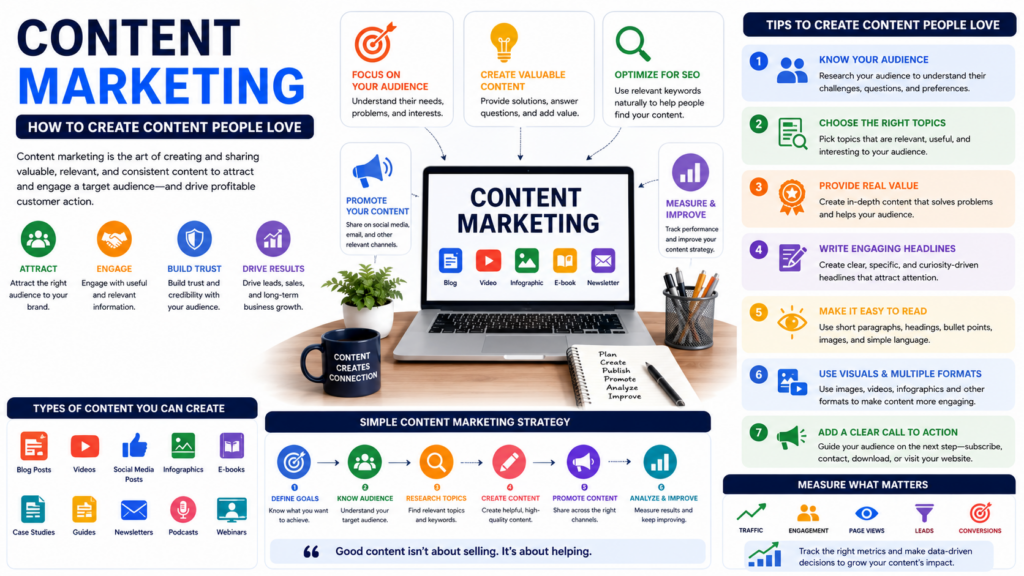
In today’s digital world, people are constantly searching for useful information online. This is why content marketing has become an important part of a successful digital marketing strategy.
From blog posts and videos to social media posts and guides, valuable content helps businesses attract the right audience, build trust, and create long-term customer relationships.
What Is Content Marketing?
Content marketing is the process of creating and sharing useful, relevant, and valuable content to attract and engage a target audience.
The goal is not simply to promote a product or service. Instead, content marketing focuses on providing information that helps people solve problems, answer questions, or make better decisions.
Examples of content marketing include:
- Blog posts
- Videos
- Social media posts
- Infographics
- E-books
- Case studies
- Guides
- Newsletters
- Podcasts
Why Is Content Marketing Important?
Good content can help businesses connect with potential customers at different stages of their buying journey.
A strong content marketing strategy can help you:
- Increase website traffic
- Improve brand awareness
- Build trust and credibility
- Support SEO
- Generate leads
- Increase audience engagement
- Educate potential customers
- Support conversions and sales
How to Create Content People Love
Creating content that people enjoy and find useful starts with understanding your audience.
1. Know Your Target Audience
Before creating content, understand who you are speaking to.
Think about:
- What problems do they have?
- What questions are they asking?
- What information are they searching for?
- What type of content do they prefer?
- What motivates them to take action?
Knowing your audience helps you create content that feels relevant and useful.
2. Choose the Right Topics
Choose topics that your audience actually wants to read or watch.
For example, if your audience is interested in digital marketing, topics such as SEO tips, social media marketing, Google Ads, content strategy, and digital marketing trends can provide useful information.
Keyword research can also help you discover relevant search terms and content ideas.
3. Provide Real Value
People are more likely to engage with content that helps them solve a problem or learn something new.
Instead of simply promoting your business, focus on providing practical information, examples, tips, and solutions.
Ask yourself:
“What will the reader learn or gain from this content?”
4. Create Attention-Grabbing Headlines
Your headline is often the first thing people notice.
A good headline should be:
- Clear
- Specific
- Useful
- Easy to understand
- Relevant to the topic
For example:
Less effective:
“SEO Information”
Better:
“10 Easy SEO Tips to Improve Your Website Ranking”
5. Keep Your Content Easy to Read
Online readers often scan content rather than reading every word.
Make your content easier to understand by using:
- Short paragraphs
- Clear headings
- Bullet points
- Simple language
- Images and graphics
- Examples
A reader-friendly format can improve the overall user experience.
6. Use SEO Naturally
SEO content can help your articles appear in relevant search results.
Use relevant keywords naturally in:
- Page titles
- Headings
- Introduction
- Body content
- Image alt text
- Meta descriptions
Avoid excessive keyword repetition. Content should be written primarily for people, not just search engines.
7. Use Different Content Formats
Not everyone consumes information in the same way.
Try different formats such as:
- Blog articles
- Short videos
- Reels
- Infographics
- Carousels
- Tutorials
- Case studies
- Email newsletters
Testing different formats can help you discover what your audience responds to best.
8. Tell Stories
Stories can make content more memorable and engaging.
Instead of only presenting facts, use real examples, experiences, challenges, and solutions when appropriate.
For example, a business could share a story about how a marketing strategy helped improve website traffic or generate leads.
9. Add a Clear Call to Action
After providing useful information, guide your audience toward the next step.
A call to action (CTA) could encourage users to:
- Read another blog
- Visit your website
- Contact your business
- Subscribe to a newsletter
- Download a guide
- Request more information
A clear CTA makes it easier for interested visitors to continue their journey.
Content Marketing and SEO
Content marketing and SEO work well together.
High-quality content can help a website target relevant search queries and provide useful answers to users. At the same time, SEO practices can help search engines discover and understand that content.
A simple strategy is:
Keyword Research → Create Helpful Content → Optimize → Publish → Promote → Measure → Improve
How to Measure Content Marketing Success
Creating content is only one part of content marketing. You should also track how your content performs.
Important metrics can include:
- Website traffic
- Organic traffic
- Page views
- Engagement
- Time spent on a page
- Social shares
- Leads
- Conversions
- Email sign-ups
Use these insights to understand which topics and formats are most valuable to your audience.
Common Content Marketing Mistakes
Avoid these common mistakes:
- Creating content without knowing your audience
- Focusing only on selling
- Using too many keywords
- Publishing low-quality or duplicate content
- Ignoring SEO
- Using complicated language
- Not promoting your content
- Failing to measure results
- Publishing inconsistently
Simple Content Marketing Strategy for Beginners
If you’re just starting, follow these steps:
1. Define your goal
Decide whether you want traffic, awareness, leads, engagement, or sales.
2. Understand your audience
Research their needs, interests, and problems.
3. Research topics and keywords
Find subjects that are useful and relevant to your audience.
4. Create valuable content
Focus on answering questions and solving problems.
5. Optimize for SEO
Use relevant keywords naturally and make your content easy for search engines and users to understand.
6. Promote your content
Share it through social media, email, and other relevant channels.
7. Measure performance
Track traffic, engagement, leads, and conversions.
8. Improve continuously
Use your data to create better content in the future.
Final Thoughts
Content marketing is not about creating as much content as possible. It is about creating the right content for the right audience at the right time.
When you understand your audience, provide genuine value, use SEO naturally, and create content in different formats, you can build stronger relationships with your audience and support long-term business growth.
The best content answers questions, solves problems, educates people, and gives them a reason to come back.
Frequently Asked Questions
What is content marketing?
Content marketing is the creation and distribution of valuable and relevant content to attract, engage, and build relationships with a target audience.
What are examples of content marketing?
Examples include blogs, videos, social media posts, infographics, e-books, newsletters, podcasts, guides, and case studies.
Why is content marketing important for SEO?
Useful and relevant content can help websites provide better answers to search queries and target topics that potential customers are searching for.
How often should I publish content?
There is no universal publishing schedule. Focus on creating high-quality, useful content consistently rather than publishing content simply to increase the number of posts.
What makes content engaging?
Content becomes more engaging when it is useful, easy to understand, relevant to the audience, visually appealing, and focused on solving real problems.