
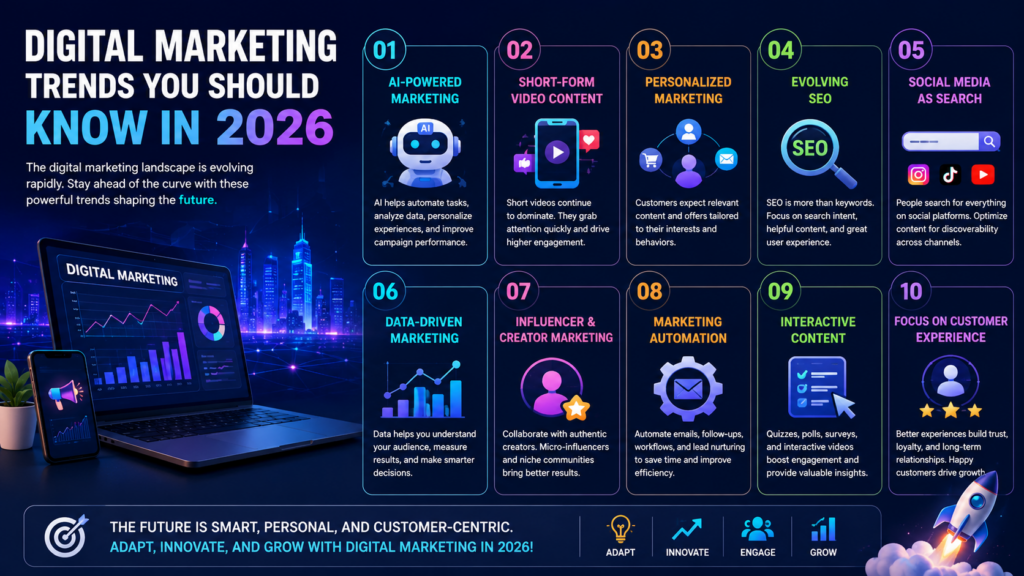
Digital marketing is constantly changing as technology, consumer behavior, and online platforms evolve. In 2026, digital marketing is becoming more focused on artificial intelligence, personalization, short-form video, data-driven strategies, and better customer experiences.
For businesses and marketers, understanding the latest digital marketing trends can help create more effective campaigns and stay competitive online.
1. Artificial Intelligence in Digital Marketing
Artificial Intelligence (AI) is becoming an important part of modern marketing. Marketers can use AI tools to support content creation, audience research, campaign analysis, customer service, and personalization.
AI can help marketers:
- Generate content ideas
- Analyze marketing data
- Identify audience trends
- Automate repetitive tasks
- Personalize customer experiences
- Improve campaign optimization
However, human creativity, strategy, fact-checking, and brand understanding remain important when using AI.
2. Short-Form Video Content
Short-form videos continue to be an important content format for attracting attention online.
Platforms such as Instagram, YouTube, and other social platforms provide opportunities for brands to communicate their messages through short, engaging videos.
Businesses can use short-form videos for:
- Product demonstrations
- Educational tips
- Customer testimonials
- Behind-the-scenes content
- Quick tutorials
- Brand storytelling
The key is to create content that provides value while capturing attention quickly.
3. Personalized Marketing
Customers increasingly expect brands to provide experiences that are relevant to their interests and needs.
Personalized marketing uses customer information and behavioral signals to deliver more relevant content, recommendations, offers, and communications.
Examples include personalized email campaigns, product recommendations, targeted content, and audience-specific advertising.
4. Search Engine Optimization Is Evolving
SEO continues to be an important part of digital marketing, but search behavior is becoming more diverse.
People increasingly use different ways to discover information, including traditional search engines, social platforms, video platforms, and AI-powered search experiences.
Modern SEO should focus on:
- Helpful and original content
- Search intent
- Strong website experience
- Relevant keywords
- Clear content structure
- Credibility and expertise
- Technical website performance
Instead of focusing only on rankings, businesses should aim to provide the best possible answer to their audience’s needs.
5. Social Media as a Search Platform
Social media is no longer used only for entertainment and communication. Many users also use social platforms to discover products, brands, reviews, tutorials, and information.
This means businesses should optimize social content for discoverability by using relevant keywords, clear captions, descriptive titles, hashtags where appropriate, and useful content.
6. Data-Driven Marketing
Data continues to play an important role in digital marketing.
Marketers can analyze campaign performance to understand what is working and where improvements are needed.
Important metrics include:
- Website traffic
- Engagement rate
- Click-through rate
- Conversion rate
- Cost per acquisition
- Return on ad spend (ROAS)
- Customer acquisition cost
Using data can help businesses make better marketing decisions instead of relying only on assumptions.
7. Influencer and Creator Marketing
Influencer and creator marketing continues to provide brands with opportunities to connect with niche audiences.
Instead of focusing only on large influencers, businesses can work with creators who have smaller but highly engaged and relevant communities.
Authenticity and audience relevance are often more important than follower count alone.
8. Marketing Automation
Marketing automation helps businesses automate repetitive marketing activities.
Examples include:
- Email sequences
- Lead nurturing
- Customer segmentation
- Campaign workflows
- Notifications
- Follow-up communication
Automation can save time and allow marketers to focus more on strategy and creative work.
9. Interactive and Engaging Content
Audiences are increasingly looking for content that encourages participation rather than simply presenting information.
Businesses can use:
- Polls
- Quizzes
- Interactive videos
- Surveys
- Calculators
- Questions
- Interactive social media content
Interactive content can encourage engagement and provide useful insights into audience preferences.
10. Focus on Customer Experience
Digital marketing is not only about attracting customers. It is also about creating a smooth experience throughout the customer journey.
A strong customer experience includes:
Discovery → Engagement → Consideration → Purchase → Support → Loyalty
Businesses should make it easy for customers to find information, navigate websites, contact the business, make purchases, and receive support.
How Businesses Can Prepare for 2026
Businesses do not need to adopt every new trend immediately. Instead, focus on trends that match your audience and business goals.
A simple approach is:
- Understand your target audience.
- Review your current digital marketing strategy.
- Identify channels that perform well.
- Experiment with new content formats and technologies.
- Use data to measure results.
- Improve campaigns continuously.
Final Thoughts
The digital marketing landscape in 2026 is becoming more AI-assisted, personalized, video-focused, data-driven, and customer-centric.
The most successful marketers will not simply follow every trend. They will understand their audience, test new strategies, measure performance, and adapt to changing customer behavior.
By combining SEO, social media marketing, content marketing, performance marketing, email marketing, AI tools, and data analytics, businesses can build a stronger online presence and create meaningful connections with their customers.
Frequently Asked Questions
What are the biggest digital marketing trends in 2026?
Some important trends include AI in marketing, short-form video, personalization, evolving SEO, social search, data-driven marketing, creator marketing, automation, interactive content, and customer experience.
Is AI important for digital marketing in 2026?
Yes. AI can support many marketing activities, including content ideation, data analysis, automation, personalization, and campaign optimization. Human oversight remains important.
Is SEO still important in 2026?
Yes. SEO remains important, but marketers should focus on helpful content, search intent, website experience, credibility, and visibility across changing search experiences.
Why is video marketing important?
Video can communicate information quickly and engage audiences across social media, websites, and other digital platforms. Short-form videos are particularly useful for educational and promotional content.
How can a small business use these trends?
Small businesses can start by focusing on a few relevant areas, such as SEO, social media, short-form video, content marketing, email marketing, and data-driven campaign optimization. The goal should be consistent improvement rather than trying every trend at once.