
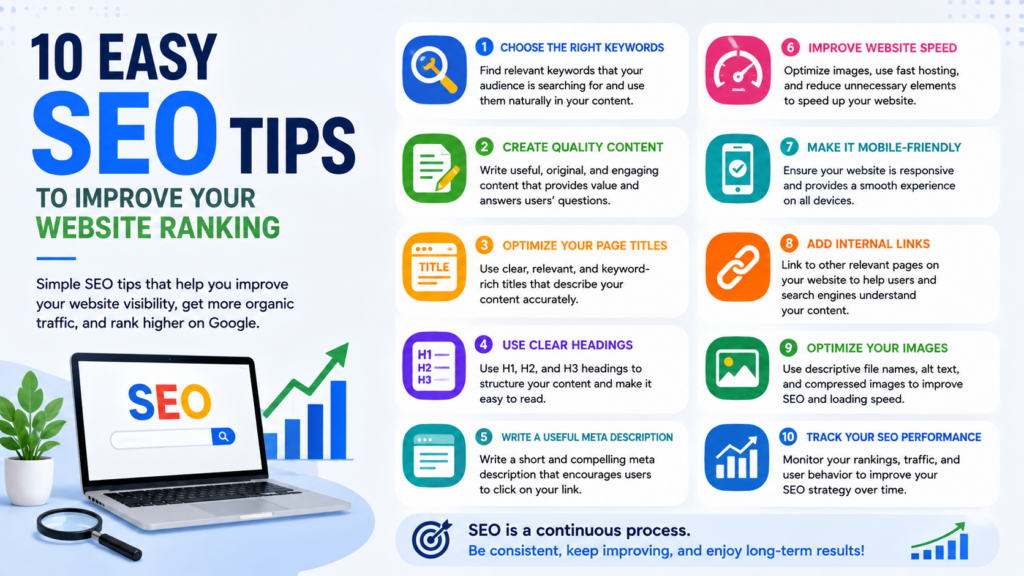
Want more people to find your website on Google? Search Engine Optimization (SEO) can help improve your website’s visibility and attract relevant organic traffic.
SEO may sound complicated, but beginners can start with a few simple and effective techniques. Here are 10 easy SEO tips to help improve your website ranking.
1. Choose the Right Keywords
Start by finding keywords that your target audience is searching for. Use relevant keywords naturally in your page title, headings, introduction, and content.
For example, if you provide digital marketing services, keywords such as digital marketing, SEO services, social media marketing, and online marketing may be relevant.
2. Create Helpful, High-Quality Content
Content is an important part of SEO. Create useful and original content that answers your audience’s questions and solves their problems.
Instead of writing content only for search engines, focus on creating content that provides real value to readers.
3. Optimize Your Page Titles
Your page title tells both users and search engines what your page is about. Keep it clear, relevant, and descriptive.
For example:
Better: 10 Easy SEO Tips to Improve Your Website Ranking
Less Effective: SEO Tips
4. Use Clear Headings
Break your content into sections using headings such as H1, H2, and H3. Clear headings make your content easier to read and help search engines understand its structure.
Include relevant keywords in headings where they fit naturally.
5. Write a Useful Meta Description
A meta description is a short summary that can appear below your page title in search results. Write a clear description that explains what readers will learn from the page.
For example:
Discover 10 simple SEO tips to improve website ranking, increase organic traffic, and build a stronger online presence.
6. Improve Website Loading Speed
Users prefer websites that load quickly. A slow website can create a poor user experience.
To improve website performance, consider:
- Compressing large images
- Reducing unnecessary website elements
- Using efficient image formats
- Improving hosting performance
- Removing unnecessary scripts and plugins
7. Make Your Website Mobile-Friendly
Many people access websites through smartphones and tablets. Make sure your website works well on different screen sizes.
A mobile-friendly website should have readable text, easy navigation, responsive design, and buttons that are simple to tap.
8. Add Internal Links
Internal linking means linking one page of your website to another relevant page.
For example, a blog about SEO can link to your pages about digital marketing, content marketing, or social media marketing.
Internal links help visitors discover more content and help search engines understand the relationship between pages on your website.
9. Optimize Your Images
Images can improve the visual appeal of your website, but they should also be optimized.
Use descriptive file names and relevant alt text for images. Compress images when possible to help improve page loading speed.
For example, instead of a file name like IMG1234.jpg, use something descriptive such as digital-marketing-strategy.jpg.
10. Track Your SEO Performance
SEO is an ongoing process. Regularly monitor your website performance to understand what is working and what needs improvement.
Important SEO metrics can include:
- Organic traffic
- Search rankings
- Click-through rate
- Impressions
- Conversions
- Engagement
Use performance data to improve your content and SEO strategy over time.
Why Is SEO Important for Your Website?
A strong SEO strategy can help your website become more visible to people searching for information, products, or services related to your business.
Good SEO can help you:
- Increase organic website traffic
- Improve online visibility
- Reach relevant audiences
- Build credibility and trust
- Generate more leads
- Support long-term business growth
Final Thoughts
Improving your website ranking does not happen overnight. SEO requires consistent effort, useful content, technical improvements, and regular performance analysis.
Start with these 10 simple SEO tips and focus on creating a website that is helpful, easy to use, fast, and relevant to your audience. Over time, a well-planned SEO strategy can help strengthen your online presence and attract more organic visitors.
Frequently Asked Questions
What is SEO?
SEO, or Search Engine Optimization, is the process of improving a website so that it can appear more prominently in relevant search engine results.
How long does SEO take to show results?
SEO results can vary depending on factors such as competition, website quality, content, and industry. SEO generally requires consistent effort rather than producing instant results.
Are keywords still important for SEO?
Yes, keywords help describe the topics covered on a page. However, they should be used naturally, with the main focus on creating helpful content for users.
Can I do SEO myself?
Yes. Beginners can learn and apply many basic SEO practices, including keyword research, content optimization, internal linking, image optimization, and improving website usability.
What is the most important SEO tip?
One of the most important principles is to create helpful, reliable, people-focused content that satisfies what users are looking for while maintaining a technically sound website.